Top Menu

Tampilkan postingan dengan label sauropoda. Tampilkan semua postingan

' Anaconda ' memenuhi ' Jurassic Park ' : Fosil ular dari India yang diberi tukik dinosaurus ==T-REC-komunitas reptil-semarang--KSE-komunitas satwa eksotik

08.54
SILAHKAN MENGGUNAKAN " MESIN TRANSLATE "..GOOGLE TRANSLATE
DISAMPING KANAN INI.............

PLEASE USE ........ "TRANSLATE MACHINE" .. GOOGLE TRANSLATE BESIDE RIGHT THIS

.................


T-REC -TUGUMUDA REPTILES COMMUNITY-INDONESIA


More info :
www.trecsemarang2011.blogspot.com
minat gabung : ( menerima keanggotaan seluruh kota dan daerah di Indonesia )
08995557626
..................................
KSE – KOMUNITAS SATWA EKSOTIK – EXOTIC PETS COMMUNITY-- INDONESIA
Visit Our Community and Joint W/ Us....Welcome All Over The World
www.facebook.com/groups/komunitassatwaeksotik/
 KSE = KOMUNITAS SATWA EKSOTIK

MENGATASI KENDALA MINAT DAN JARAK

KAMI ADA DI TIAP KOTA DI INDONESIA
DETAIL TENTANG KSE-----KLIK : www.komunitassatwaeksotik-pendaftaran.blogspot.com

GABUNG......... ( menerima keanggotaan seluruh kota dan daerah di Indonesia )
HUBUNGI   :  089617123865-08995557626

.........................
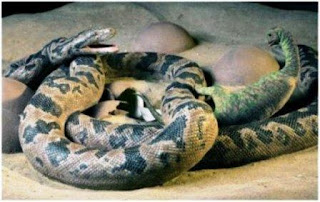


' Anaconda ' memenuhi ' Jurassic Park ' : Fosil ular dari India yang diberi tukik dinosaurus 

Date:
March 2, 2010
Source:
University of Michigan
Summary:

Enam puluh tujuh juta tahun yang lalu , ketika tukik dinosaurus pertama  bergegas keluar dari telur mereka , itu adalah yang pertama  - dan terakhir-bagi mereka - mungkin setelah adanya rahang terbuka  dari ular dengan panjang 3,5 meter  bernama Sanajeh indicus , berdasarkan penemuan di India dari kerangka fosil yang hampir lengkap dari ular primitif yang melingkar di dalam sarang dinosaurus .


................ Sebuah tim paleontologis internasional yang dipimpin oleh University of Michigan ,Jeff Wilson dan Survei Geologi India Dhananjay Mohabey akan mempublikasikan penemuan mereka secara online 2 Maret di jurnal PLoS biologi .

Sisa-sisa ular yang hampir lengkap ditemukan awet dalam sarang dinosaurus sauropoda  dewasa yang merupakan  hewan terbesar yang diketahui hidup di bumi . Ular itu melingkar di sekitar telur yang baru menetas dan berdekatan dengan tukik sauropod..............more


'Anaconda' meets 'Jurassic Park': Fossil snake from India fed on hatchling dinosaurs
Date:
March 2, 2010
Source:
University of Michigan
Summary:
Sixty-seven million years ago, when dinosaur hatchlings first scrambled out of their eggs, their first -- and last -- glimpse of the world might have been the open jaws of a 3.5-meter-long snake named Sanajeh indicus, based on the discovery in India of a nearly complete fossilized skeleton of a primitive snake coiled inside a dinosaur nest.
..............
The remains of an extraordinary fossil unearthed in 67-million-year-old sediments from Gujarat, western India provide a rare glimpse at an unusual feeding behavior in ancient snakes.
An international paleontological team led by the University of Michigan's Jeff Wilson and the Geological Survey of India's Dhananjay Mohabey will publish their discovery online March 2 in the open-access journal PLoS Biology.
The remains of a nearly complete snake were found preserved in the nest of a sauropod dinosaur, adults of which are the largest animals known to have walked the earth. The snake was coiled around a recently hatched egg adjacent to a hatchling sauropod. Remains of other snake individuals associated with egg clutches at the same site indicate that the newly described snake made its living feeding on young dinosaurs.
"It was such a thrill to discover such a portentous moment frozen in time," said Mohabey, who made the initial discovery in the early 1980s.
Working with the sediment-covered and inscrutable specimen in 1987, Mohabey recognized dinosaur eggshell and limb bones but was unable to fully interpret the specimen. In 2001, Wilson visited Mohabey at his office at the Geological Survey of India and was astonished when he examined the specimen.
"I saw the characteristic vertebral locking mechanism of snakes alongside dinosaur eggshell and larger bones, and I knew it was an extraordinary specimen---but I also knew we needed to develop it further," Wilson said.
From that point began a decade-long odyssey that led to a formal agreement with the Government of India Ministry of Mines in 2004 that allowed preparation and study of the fossil at the U-M Museum of Paleontology, weeks of museum study in India, and field reconnaissance at the original locality in Gujarat by a team that included Wilson, Mohabey, snake expert Jason Head of the University of Toronto-Mississaugua, and geologist Shanan Peters of the University of Wisconsin. The field research was funded by the National Geographic Society.
Preparation of the fossil at the U-M revealed the snake was coiled around a crushed dinosaur egg next to a freshly hatched sauropod dinosaur.
"We think that the hatchling had just exited its egg, and that activity attracted the snake," said Mohabey. "The eggs were lain in the loose sands near a small drainage and covered by a thin layer of sediment."
The arrangement of the bones and delicate structures, such as eggshells and the snake's skull, point to quick entombment.
"Sedimentation was unusually rapid and deep for this formation---a pulse of sand, probably mobilized during a storm, resulted in the preservation of this spectacular association," said Peters, who interpreted the paleoenvironment of the site.
The new snake, which was named Sanajeh indicus or "ancient-gaped one from the Indian subcontinent," because of its lizard-like gape, adds critical information that helps resolve the early diversification of snakes. Modern large-mouthed snakes are able to eat large prey because they have mobile skulls and wide gapes. Sanajeh bears only some of the traits of modern large-mouthed snakes and provides insight into how they evolved.
"Sanajeh was capable of ingesting the half meter-long sauropod hatchling because it was quite large itself, almost 3.5 meters long," Head said. "This points to an interesting evolutionary strategy for primitive snakes to eat large prey by increasing their body size."
Although the sauropod dinosaurs that Sanajeh preyed upon include the largest animals capable of walking on land, they began their life as small hatchlings that were about one-seventh the length of Sanajeh. Sauropods appear to have achieved their enormous size by virtue of a fast-growth phase, which would have kept them out of danger from Sanajeh-sized predators by the end of their first year of life.
This discovery of Sanajeh adds to a growing body of evidence suggesting that the Indian subcontinent retained ties to southern landmasses for longer than once hypothesized. Sanajeh's closest relatives are from Australia and speak to its strong ties to southern continents, collectively known as Gondwana.
A life-sized flesh reconstruction of the scene immediately before burial was designed and executed by University of Chicago paleoartist Tyler Keillor. The team will donate the first cast to the Geological Survey of India at a formal function to be held in Mumbai, India, on March 12, 2010.


Story Source:
The above post is reprinted from materials provided byUniversity of Michigan. Note: Materials may be edited for content and length.


Journal Reference:
1.    Wilson JA, Mohabey DM, Peters SE, Head JJ. Predation upon Hatchling Dinosaurs by a New Snake from the Late Cretaceous of India. PLoS Biology, 2010; 8(3): e1000322 DOI: 10.1371/journal.pbio.1000322


Dinosaurus pemakan Tanaman ditemukan di Antarktika--T-REC semarang--komunitas reptil semarang

05.05


 SILAHKAN MENGGUNAKAN " MESIN TRANSLATE "..GOOGLE TRANSLATE 
DISAMPING KANAN INI.............


PLEASE USE ........ "TRANSLATE MACHINE" .. GOOGLE TRANSLATE BESIDE RIGHT THIS

....................................


Dinosaurus pemakan Tanaman ditemukan di Antarktika


Plant-eating dinosaur discovered in Antarctica
Date:
December 19, 2011
Source:
Springer
Summary:
For the first time, the presence of large bodied herbivorous dinosaurs in Antarctica has been recorded. Until now, remains of sauropoda had been recovered from all continental landmasses, except Antarctica. The identification of the remains of the sauropod dinosaur suggests that advanced titanosaurs achieved a global distribution at least by the Late Cretaceous.
.......................
For the first time, the presence of large bodied herbivorous dinosaurs in Antarctica has been recorded. Until now, remains of sauropoda -- one of the most diverse and geographically widespread species of herbivorous dinosaurs -- had been recovered from all continental landmasses, except Antarctica. Dr. Ignacio Alejandro Cerda, from CONICET in Argentina, and his team's identification of the remains of the sauropod dinosaur suggests that advanced titanosaurs (plant-eating, sauropod dinosaurs) achieved a global distribution at least by the Late Cretaceous*.
Their work has just been published online in Springer's journal Naturwissenschaften - The Science of Nature.
Sauropoda is the second most diverse group of dinosaurs, with more than 150 recognized species. It includes the largest terrestrial vertebrates that ever existed. Although many sauropod remains have been discovered in North and South America, Africa, Asia, Australia and Europe, there is no previous record of sauropoda in Antarctica. Other important dinosaur discoveries have been made in Antarctica in the last two decades -- principally in the James Ross Basin.Dr. Cerda and colleagues report the first finding of a sauropod dinosaur from this continent and provide a detailed description of an incomplete middle-tail vertebra, recovered from James Ross Island. The specific size and morphology of the specimen, including its distinctive ball and socket articulations, lead the authors to identify it as an advanced titanosaur.
These titanosaurs originated during the Early Cretaceous and were the predominant group of sauropod dinosaurs until the extinction of all non-bird dinosaurs at the end of the Cretaceous. Although they were one of the most widespread and successful species of sauropod dinosaurs, their origin and dispersion are not completely understood.
The authors conclude: "Our discovery, and subsequent report, of these sauropod dinosaur remains from Antarctica improves our current knowledge of the dinosaurian faunas during the Late Cretaceous on this continent."*The Cretaceous Period spanned 99.6-65.5 million years ago, and ended with the extinction of the dinosaurs.
*Note: The Cretaceous Period spanned 99.6-65.5 million years ago, and ended with the extinction of the dinosaurs.

Story Source:
The above story is based on materials provided by Springer. Note: Materials may be edited for content and length.

Journal Reference:
  1. Ignacio A. Cerda, Ariana Paulina Carabajal, Leonardo Salgado, Rodolfo A. Coria, Marcelo A. Reguero, Claudia P. Tambussi, Juan J. Moly. The first record of a sauropod dinosaur from Antar


Designed By OddThemes | Distributed By Gooyaabi Templates